
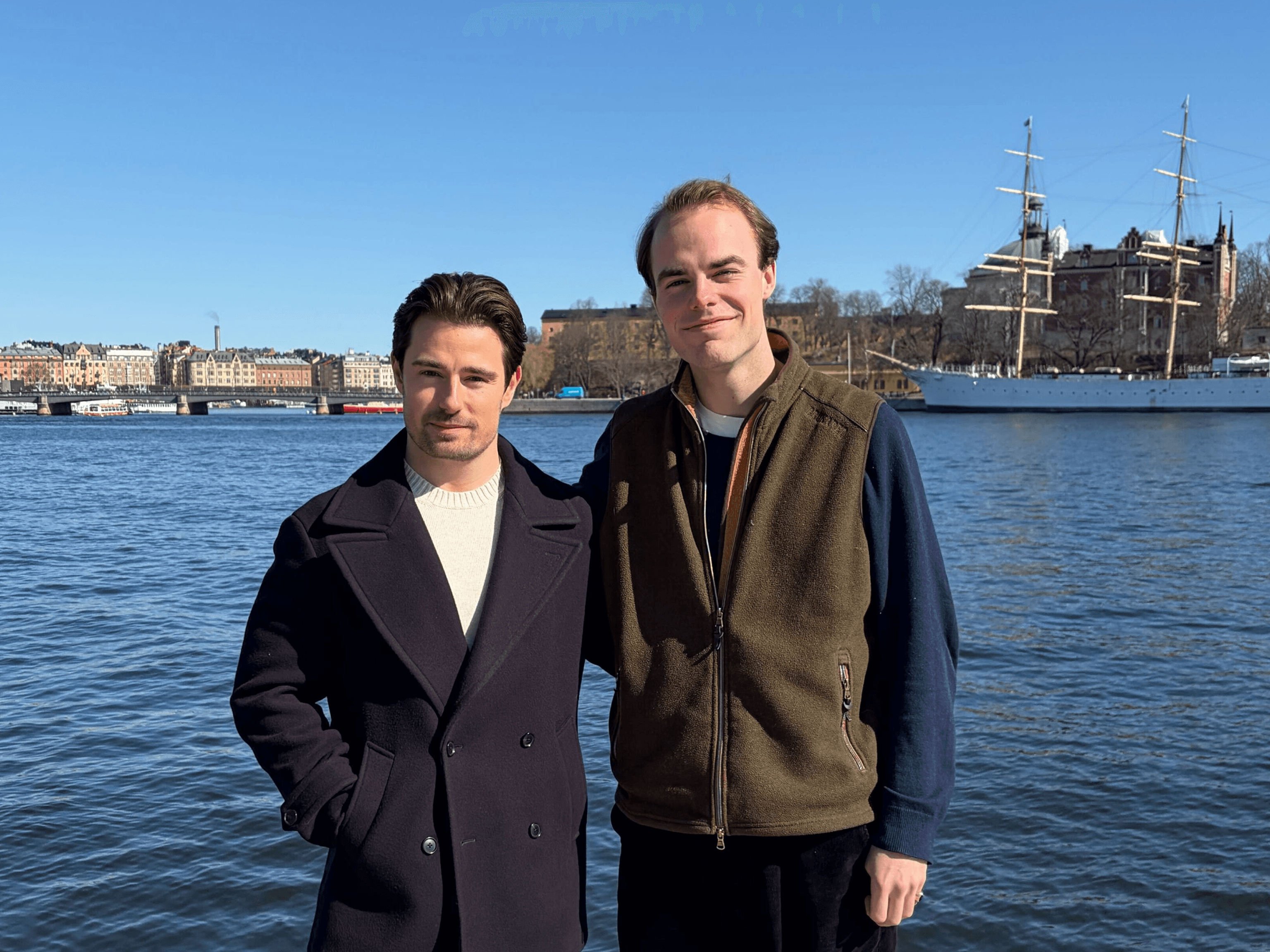
Meet Edward & Marcus - Centi's Intern Duo
Edward joined from law, Marcus from Nordic Capital and SSE Finance. Learn why they chose Centi, what real responsibility looks like from day one, and how AI reshaped the work, one task dropped from two days to 20 minutes.
Hi guys! Can you tell us a bit about your role at Centi and what made you want to join the team?
Marcus: I'm part of the Client Services team, focusing on onboarding new portfolio companies to the platform. On a daily basis, I work closely with legal counsel, deal teams, and CFOs to gather all the necessary ownership data before setting it up in Centi's platform where I'm building out the cap table and ownership structure, valuing securities, and configuring incentive programs.
Beyond the core onboarding work, I'm heavily involved in process improvements and constantly looking for ways to simplify and streamline the migration experience for new clients. Also, no two days look the same. For example I might help the legal team with complex documents, programming variables to automate the distribution process when making offers for incentive programs. The next day I could be supporting the sales team on marketing and expansion efforts to new markets in the UK and US.
I previously worked at Nordic Capital alongside our CEO and Co-founder George, so joining Centi felt like a natural step. Seeing the team he'd built and the product they have created made it an easy decision. What really drew me in was the opportunity to bring together my background in finance and tech within a single role, and the energy of a fast-moving startup where you're constantly learning and solving new problems.
Edward: Hi! I work as an intern in the Client Services team here at Centi. The role is very dynamic and the work consists of a variety of tasks. I mainly work with the more day-to-day issues that arise within our clients’ incentive programmes, such as handling share repurchases, new investments, or restructurings of the programmes.
My first introduction to Centi was through an interview with our predecessor Jacob. His description of the intern position at Centi as undefined, with the freedom of structuring one's own work and taking initiatives, is what first made me interested in applying for the role. A major selling point of the role was definitely the experience available within Centi. I felt that working within an environment with so much experience from work at international law firms and private equity funds would be a great environment to learn in.
Edward, client services at a fintech feels like an unusual choice for a law student, most of your peers are probably gunning for law firm placements. What's the case for doing something like this instead?
The biggest thing for me was the level of responsibility and freedom, which I think would be hard to achieve in a junior position at a law firm. When we are given assignments, everyone goes out of their way to make sure that we understand all the context around the task, things like why we do something, any relevant historical or legal background, etc. That makes it possible for us to take full responsibility for the assignment and outcome, which has been very fun and rewarding. We are also encouraged to identify what we find interesting and want to learn more about.
What I think makes working at Centi very different from working at a law firm is that Centi is primarily a tech company. This makes the focus of the work different, and it also means that Centi has a lot more technical expertise in-house than a law firm would. Working with such competent colleagues, especially during the integration of AI, has been very rewarding for me as a non-technical law student. I am in no position to speculate on how the world economy will develop, but it can be presumed that technology in general, and possibly also AI, will play a big role in the future. I think having experience from a company at the forefront of that development is, in that context, very valuable.
Marcus, you spent nearly three years at Nordic Capital, when you're onboarding PE firms onto Centi, does your time at Nordic Capital give you an edge when working with clients who come from that world?
Working at a top PE firm before Centi has definitely been an advantage. The PE world has its own culture, pace, and expectations, and having been on the inside, I know how to speak their language and deliver in a way that makes onboarding feel smoother and more tailored.
That said, even if you haven't come from a PE background, working at Centi exposes you to a huge range of PE firms and fund structures. Over time you naturally build a strong picture of how the industry works, how firms are organized, and what they care about. And on top of that, you build great connections across the industry along the way.
Edward, you come from a legal background but you're working directly with clients day-to-day. What have you had to learn on the fly, and has anything from your law studies shown up in ways you didn't expect?
I have been positively surprised by how often we have to tackle law-related questions in our day-to-day work. These questions often show up even in situations that at first can seem purely commercial. Having tackled similar questions within the confines of the courses in corporate law given through the law programme, it has been very interesting to see how they are solved and handled in real commercial settings.
A big adjustment for me has been the use of AI. We started integrating AI into our work during my second week at Centi, and the differences were huge. A task that took me two days to complete in my first week could in my second week be solved within 20 minutes. Having this insight into how one can work with AI has been very rewarding, especially seeing as we do tasks that would otherwise probably have been handled by a law firm.
Marcus, you're deep in Finance theory at SSE while simultaneously onboarding real clients at Centi — where do the two actually overlap, and where does the textbook fall short?
Right now I'm taking a Private Equity course at SSE, which makes the overlap pretty direct. We cover fund structures, waterfall mechanics, and how GPs and LPs interact. These are the building blocks of exactly the world Centi operates in. Having that theoretical foundation definitely helps when speaking with clients and understanding the context they operate in.
Where the textbook falls a bit short is in how things actually work operationally. In class you learn the structure of a fund and the logic behind things like waterfalls, but you don't really see the complexity of how firms manage the processes behind it day-to-day. Working with clients at Centi adds that missing layer.
Finally, what would you say to a law or business student sitting on the fence about applying for an internship at Centi?
Marcus: Centi offers a rare combination that's hard to find at this stage of your career. You get direct exposure to the PE world, real responsibility from day one, and a front-row seat to how modern fintech is reshaping how equity is managed. You'll quickly develop a deep understanding of complex ownership structures, transactions, and the legal and financial mechanics that sit behind them. But beyond the technical knowledge, you'll also be working in an environment that genuinely encourages you to take initiative, ask questions, and grow. It doesn't feel like a typical internship where you're handed the smallest possible tasks. You're contributing to real work with real clients.
Edward: An internship at Centi puts you at the intersection of the startup world and private equity, with direct exposure to some of the largest international law firms in the Nordics and beyond. You will work alongside experienced colleagues who genuinely invest in your development. The environment is encouraging, collaborative, and very different from the hierarchical world of corporate law. For law students in particular, this is a rare chance to engage with real, practical legal problems in an interesting and fast-moving context.
Meet Edward & Marcus - Centi's Intern Duo
Edward joined from law, Marcus from Nordic Capital and SSE Finance. Learn why they chose Centi, what real responsibility looks like from day one, and how AI reshaped the work, one task dropped from two days to 20 minutes.
Hi guys! Can you tell us a bit about your role at Centi and what made you want to join the team?
Marcus: I'm part of the Client Services team, focusing on onboarding new portfolio companies to the platform. On a daily basis, I work closely with legal counsel, deal teams, and CFOs to gather all the necessary ownership data before setting it up in Centi's platform where I'm building out the cap table and ownership structure, valuing securities, and configuring incentive programs.
Beyond the core onboarding work, I'm heavily involved in process improvements and constantly looking for ways to simplify and streamline the migration experience for new clients. Also, no two days look the same. For example I might help the legal team with complex documents, programming variables to automate the distribution process when making offers for incentive programs. The next day I could be supporting the sales team on marketing and expansion efforts to new markets in the UK and US.
I previously worked at Nordic Capital alongside our CEO and Co-founder George, so joining Centi felt like a natural step. Seeing the team he'd built and the product they have created made it an easy decision. What really drew me in was the opportunity to bring together my background in finance and tech within a single role, and the energy of a fast-moving startup where you're constantly learning and solving new problems.
Edward: Hi! I work as an intern in the Client Services team here at Centi. The role is very dynamic and the work consists of a variety of tasks. I mainly work with the more day-to-day issues that arise within our clients’ incentive programmes, such as handling share repurchases, new investments, or restructurings of the programmes.
My first introduction to Centi was through an interview with our predecessor Jacob. His description of the intern position at Centi as undefined, with the freedom of structuring one's own work and taking initiatives, is what first made me interested in applying for the role. A major selling point of the role was definitely the experience available within Centi. I felt that working within an environment with so much experience from work at international law firms and private equity funds would be a great environment to learn in.
Edward, client services at a fintech feels like an unusual choice for a law student, most of your peers are probably gunning for law firm placements. What's the case for doing something like this instead?
The biggest thing for me was the level of responsibility and freedom, which I think would be hard to achieve in a junior position at a law firm. When we are given assignments, everyone goes out of their way to make sure that we understand all the context around the task, things like why we do something, any relevant historical or legal background, etc. That makes it possible for us to take full responsibility for the assignment and outcome, which has been very fun and rewarding. We are also encouraged to identify what we find interesting and want to learn more about.
What I think makes working at Centi very different from working at a law firm is that Centi is primarily a tech company. This makes the focus of the work different, and it also means that Centi has a lot more technical expertise in-house than a law firm would. Working with such competent colleagues, especially during the integration of AI, has been very rewarding for me as a non-technical law student. I am in no position to speculate on how the world economy will develop, but it can be presumed that technology in general, and possibly also AI, will play a big role in the future. I think having experience from a company at the forefront of that development is, in that context, very valuable.
Marcus, you spent nearly three years at Nordic Capital, when you're onboarding PE firms onto Centi, does your time at Nordic Capital give you an edge when working with clients who come from that world?
Working at a top PE firm before Centi has definitely been an advantage. The PE world has its own culture, pace, and expectations, and having been on the inside, I know how to speak their language and deliver in a way that makes onboarding feel smoother and more tailored.
That said, even if you haven't come from a PE background, working at Centi exposes you to a huge range of PE firms and fund structures. Over time you naturally build a strong picture of how the industry works, how firms are organized, and what they care about. And on top of that, you build great connections across the industry along the way.
Edward, you come from a legal background but you're working directly with clients day-to-day. What have you had to learn on the fly, and has anything from your law studies shown up in ways you didn't expect?
I have been positively surprised by how often we have to tackle law-related questions in our day-to-day work. These questions often show up even in situations that at first can seem purely commercial. Having tackled similar questions within the confines of the courses in corporate law given through the law programme, it has been very interesting to see how they are solved and handled in real commercial settings.
A big adjustment for me has been the use of AI. We started integrating AI into our work during my second week at Centi, and the differences were huge. A task that took me two days to complete in my first week could in my second week be solved within 20 minutes. Having this insight into how one can work with AI has been very rewarding, especially seeing as we do tasks that would otherwise probably have been handled by a law firm.
Marcus, you're deep in Finance theory at SSE while simultaneously onboarding real clients at Centi — where do the two actually overlap, and where does the textbook fall short?
Right now I'm taking a Private Equity course at SSE, which makes the overlap pretty direct. We cover fund structures, waterfall mechanics, and how GPs and LPs interact. These are the building blocks of exactly the world Centi operates in. Having that theoretical foundation definitely helps when speaking with clients and understanding the context they operate in.
Where the textbook falls a bit short is in how things actually work operationally. In class you learn the structure of a fund and the logic behind things like waterfalls, but you don't really see the complexity of how firms manage the processes behind it day-to-day. Working with clients at Centi adds that missing layer.
Finally, what would you say to a law or business student sitting on the fence about applying for an internship at Centi?
Marcus: Centi offers a rare combination that's hard to find at this stage of your career. You get direct exposure to the PE world, real responsibility from day one, and a front-row seat to how modern fintech is reshaping how equity is managed. You'll quickly develop a deep understanding of complex ownership structures, transactions, and the legal and financial mechanics that sit behind them. But beyond the technical knowledge, you'll also be working in an environment that genuinely encourages you to take initiative, ask questions, and grow. It doesn't feel like a typical internship where you're handed the smallest possible tasks. You're contributing to real work with real clients.
Edward: An internship at Centi puts you at the intersection of the startup world and private equity, with direct exposure to some of the largest international law firms in the Nordics and beyond. You will work alongside experienced colleagues who genuinely invest in your development. The environment is encouraging, collaborative, and very different from the hierarchical world of corporate law. For law students in particular, this is a rare chance to engage with real, practical legal problems in an interesting and fast-moving context.
Meet Edward & Marcus - Centi's Intern Duo
Edward joined from law, Marcus from Nordic Capital and SSE Finance. Learn why they chose Centi, what real responsibility looks like from day one, and how AI reshaped the work, one task dropped from two days to 20 minutes.
Hi guys! Can you tell us a bit about your role at Centi and what made you want to join the team?
Marcus: I'm part of the Client Services team, focusing on onboarding new portfolio companies to the platform. On a daily basis, I work closely with legal counsel, deal teams, and CFOs to gather all the necessary ownership data before setting it up in Centi's platform where I'm building out the cap table and ownership structure, valuing securities, and configuring incentive programs.
Beyond the core onboarding work, I'm heavily involved in process improvements and constantly looking for ways to simplify and streamline the migration experience for new clients. Also, no two days look the same. For example I might help the legal team with complex documents, programming variables to automate the distribution process when making offers for incentive programs. The next day I could be supporting the sales team on marketing and expansion efforts to new markets in the UK and US.
I previously worked at Nordic Capital alongside our CEO and Co-founder George, so joining Centi felt like a natural step. Seeing the team he'd built and the product they have created made it an easy decision. What really drew me in was the opportunity to bring together my background in finance and tech within a single role, and the energy of a fast-moving startup where you're constantly learning and solving new problems.
Edward: Hi! I work as an intern in the Client Services team here at Centi. The role is very dynamic and the work consists of a variety of tasks. I mainly work with the more day-to-day issues that arise within our clients’ incentive programmes, such as handling share repurchases, new investments, or restructurings of the programmes.
My first introduction to Centi was through an interview with our predecessor Jacob. His description of the intern position at Centi as undefined, with the freedom of structuring one's own work and taking initiatives, is what first made me interested in applying for the role. A major selling point of the role was definitely the experience available within Centi. I felt that working within an environment with so much experience from work at international law firms and private equity funds would be a great environment to learn in.
Edward, client services at a fintech feels like an unusual choice for a law student, most of your peers are probably gunning for law firm placements. What's the case for doing something like this instead?
The biggest thing for me was the level of responsibility and freedom, which I think would be hard to achieve in a junior position at a law firm. When we are given assignments, everyone goes out of their way to make sure that we understand all the context around the task, things like why we do something, any relevant historical or legal background, etc. That makes it possible for us to take full responsibility for the assignment and outcome, which has been very fun and rewarding. We are also encouraged to identify what we find interesting and want to learn more about.
What I think makes working at Centi very different from working at a law firm is that Centi is primarily a tech company. This makes the focus of the work different, and it also means that Centi has a lot more technical expertise in-house than a law firm would. Working with such competent colleagues, especially during the integration of AI, has been very rewarding for me as a non-technical law student. I am in no position to speculate on how the world economy will develop, but it can be presumed that technology in general, and possibly also AI, will play a big role in the future. I think having experience from a company at the forefront of that development is, in that context, very valuable.
Marcus, you spent nearly three years at Nordic Capital, when you're onboarding PE firms onto Centi, does your time at Nordic Capital give you an edge when working with clients who come from that world?
Working at a top PE firm before Centi has definitely been an advantage. The PE world has its own culture, pace, and expectations, and having been on the inside, I know how to speak their language and deliver in a way that makes onboarding feel smoother and more tailored.
That said, even if you haven't come from a PE background, working at Centi exposes you to a huge range of PE firms and fund structures. Over time you naturally build a strong picture of how the industry works, how firms are organized, and what they care about. And on top of that, you build great connections across the industry along the way.
Edward, you come from a legal background but you're working directly with clients day-to-day. What have you had to learn on the fly, and has anything from your law studies shown up in ways you didn't expect?
I have been positively surprised by how often we have to tackle law-related questions in our day-to-day work. These questions often show up even in situations that at first can seem purely commercial. Having tackled similar questions within the confines of the courses in corporate law given through the law programme, it has been very interesting to see how they are solved and handled in real commercial settings.
A big adjustment for me has been the use of AI. We started integrating AI into our work during my second week at Centi, and the differences were huge. A task that took me two days to complete in my first week could in my second week be solved within 20 minutes. Having this insight into how one can work with AI has been very rewarding, especially seeing as we do tasks that would otherwise probably have been handled by a law firm.
Marcus, you're deep in Finance theory at SSE while simultaneously onboarding real clients at Centi — where do the two actually overlap, and where does the textbook fall short?
Right now I'm taking a Private Equity course at SSE, which makes the overlap pretty direct. We cover fund structures, waterfall mechanics, and how GPs and LPs interact. These are the building blocks of exactly the world Centi operates in. Having that theoretical foundation definitely helps when speaking with clients and understanding the context they operate in.
Where the textbook falls a bit short is in how things actually work operationally. In class you learn the structure of a fund and the logic behind things like waterfalls, but you don't really see the complexity of how firms manage the processes behind it day-to-day. Working with clients at Centi adds that missing layer.
Finally, what would you say to a law or business student sitting on the fence about applying for an internship at Centi?
Marcus: Centi offers a rare combination that's hard to find at this stage of your career. You get direct exposure to the PE world, real responsibility from day one, and a front-row seat to how modern fintech is reshaping how equity is managed. You'll quickly develop a deep understanding of complex ownership structures, transactions, and the legal and financial mechanics that sit behind them. But beyond the technical knowledge, you'll also be working in an environment that genuinely encourages you to take initiative, ask questions, and grow. It doesn't feel like a typical internship where you're handed the smallest possible tasks. You're contributing to real work with real clients.
Edward: An internship at Centi puts you at the intersection of the startup world and private equity, with direct exposure to some of the largest international law firms in the Nordics and beyond. You will work alongside experienced colleagues who genuinely invest in your development. The environment is encouraging, collaborative, and very different from the hierarchical world of corporate law. For law students in particular, this is a rare chance to engage with real, practical legal problems in an interesting and fast-moving context.
Meet Edward & Marcus - Centi's Intern Duo
Edward joined from law, Marcus from Nordic Capital and SSE Finance. Learn why they chose Centi, what real responsibility looks like from day one, and how AI reshaped the work, one task dropped from two days to 20 minutes.